Now Postdoc at University of Michigan
Selected publications
 2026Conference paper
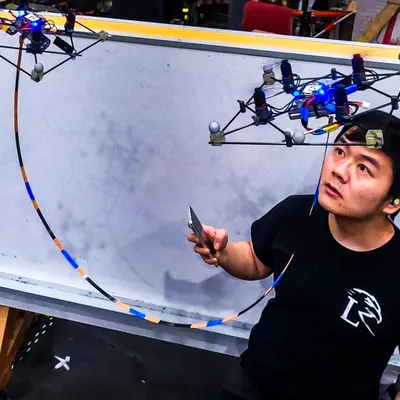
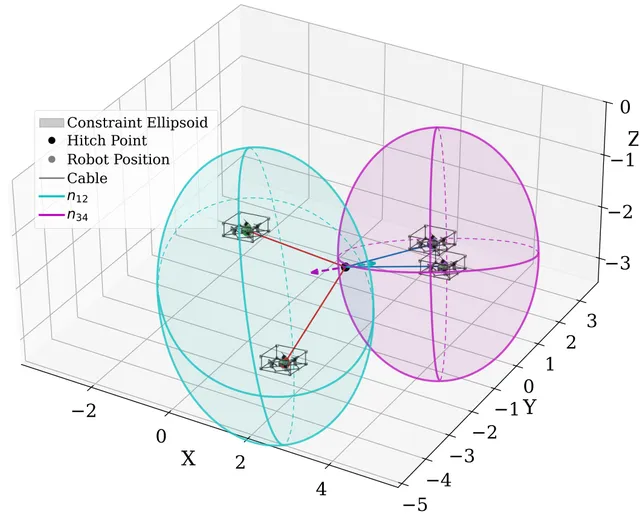
From Ellipsoids to Midair Control of Dynamic Hitches
Jiawei Xu, Subhrajit Bhattacharya, David Saldaña
2026 American Control Conference (ACC)
BibTeX
@inproceedings{xu2026ellipsoids, title={From Ellipsoids to Midair Control of Dynamic Hitches}, author={Xu, Jiawei and Bhattacharya, Subhrajit and Saldaña, David}, booktitle={2026 American Control Conference (ACC)}, year={2026}, url={https://arxiv.org/abs/2602.08116} }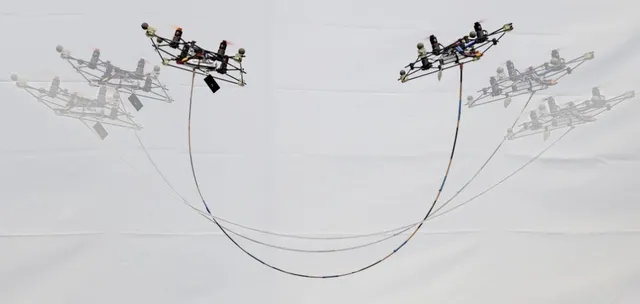 2025Journal article
AirBender: Adaptive Transportation of Bendable Objects Using Dual UAVs
Jiawei Xu, Longsen Gao, Rafael Fierro, David Saldaña
IEEE Robotics and Automation Letters
BibTeX
@article{2025-airbender-adaptive-transportation-of-bendable-objects-using-dual-uavs, title = {AirBender: Adaptive Transportation of Bendable Objects Using Dual UAVs}, author = {Jiawei Xu and Longsen Gao and Rafael Fierro and David Saldaña}, year = {2025}, journal = {IEEE Robotics and Automation Letters}, pages = {2790-2797}, volume = {10}, number = {3}, doi = {10.1109/lra.2025.3536276}, url = {https://doi.org/10.1109/lra.2025.3536276} }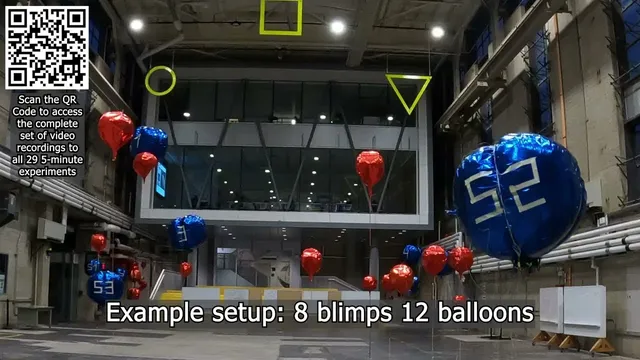 2025Conference paper
MochiSwarm: A testbed for robotic blimps in realistic environments
Jiawei Xu, Thong Vu, Diego S. D’Antonio, David Saldaña
IEEE International Conference on Robotics and Automation (ICRA)
BibTeX
@inproceedings{2025-mochiswarm, title = {MochiSwarm: A testbed for robotic blimps in realistic environments}, author = {Jiawei Xu and Thong Vu and Diego S. D’Antonio and David Saldaña}, year = {2025}, booktitle = {IEEE International Conference on Robotics and Automation (ICRA)}, url = {https://arxiv.org/abs/2503.03077} }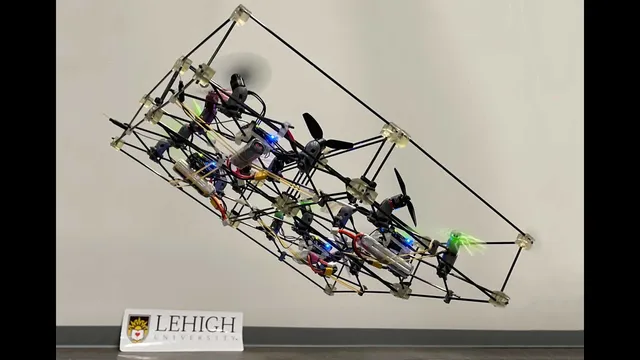 2025Journal article
Modular Multirotors: From Quadrotors to Fully-Actuated Aerial Vehicles
Jiawei Xu, Diego S. D'Antonio, David Saldaña
IEEE Transactions on Automation Science and Engineering
BibTeX
@article{2025-modular-multirotors-from-quadrotors-to-fully-actuated-aerial-vehicles, title = {Modular Multirotors: From Quadrotors to Fully-Actuated Aerial Vehicles}, author = {Jiawei Xu and Diego S. D'Antonio and David Saldaña}, year = {2025}, journal = {IEEE Transactions on Automation Science and Engineering}, pages = {19328-19339}, volume = {22}, doi = {10.1109/tase.2025.3594579}, url = {https://doi.org/10.1109/tase.2025.3594579} }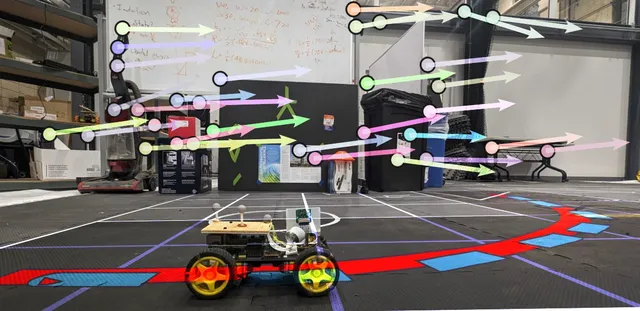 2024Conference paper
KT-Imitation: Efficient Visual Imitation for Autonomous Navigation Based on Keypoint Timeline
Karen Li, Hanqing Qi, Jiawei Xu, Edward Jeffs, David Saldaña
2024 Latin American Robotics Symposium (LARS)
BibTeX
@inproceedings{2024-kt-imitation-efficient-visual-imitation-for-autonomous-navigation-based-on-keypoint-timeline, title = {KT-Imitation: Efficient Visual Imitation for Autonomous Navigation Based on Keypoint Timeline}, author = {Karen Li and Hanqing Qi and Jiawei Xu and Edward Jeffs and David Saldaña}, year = {2024}, booktitle = {2024 Latin American Robotics Symposium (LARS)}, doi = {10.1109/lars64411.2024.10786409} }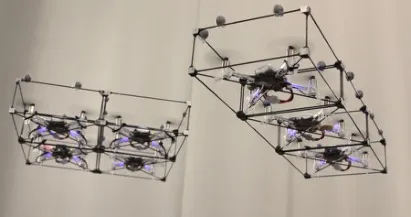 2024Conference paper
Rotor Fault Detection and Isolation in Aerial Vehicles with Dozens of Rotors
Neeraj Gandhi, Jiawei Xu, David Saldaña, Linh Thi Xuan Phan
2024 Latin American Robotics Symposium (LARS)
BibTeX
@inproceedings{2024-rotor-fault-detection-and-isolation-in-aerial-vehicles-with-dozens-of-rotors, title = {Rotor Fault Detection and Isolation in Aerial Vehicles with Dozens of Rotors}, author = {Neeraj Gandhi and Jiawei Xu and David Saldaña and Linh Thi Xuan Phan}, year = {2024}, booktitle = {2024 Latin American Robotics Symposium (LARS)}, doi = {10.1109/lars64411.2024.10786448} }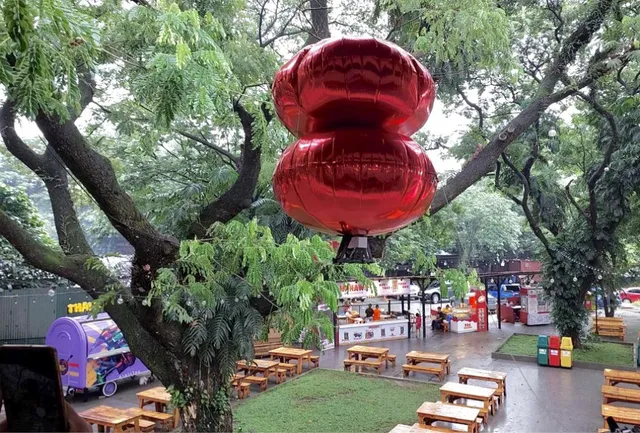 2023Conference paper
A Novel Low-Cost, Recyclable, Easy-to-Build Robot Blimp For Transporting Supplies in Hard-to-Reach Locations
Karen Li, Shuhang Hou, Matyas Negash, Jiawei Xu, Edward Jeffs, Diego S. D'Antonio, David Saldaña
2023 IEEE Global Humanitarian Technology Conference (GHTC)
BibTeX
@inproceedings{2023-a-novel-low-cost-recyclable-easy-to-build-robot-blimp-for-transporting-supplies-in-hard-to-reach-locations, title = {A Novel Low-Cost, Recyclable, Easy-to-Build Robot Blimp For Transporting Supplies in Hard-to-Reach Locations}, author = {Karen Li and Shuhang Hou and Matyas Negash and Jiawei Xu and Edward Jeffs and Diego S. D'Antonio and David Saldaña}, year = {2023}, booktitle = {2023 IEEE Global Humanitarian Technology Conference (GHTC)}, pages = {36-42}, doi = {10.1109/ghtc56179.2023.10355047}, url = {https://doi.org/10.1109/ghtc56179.2023.10355047} }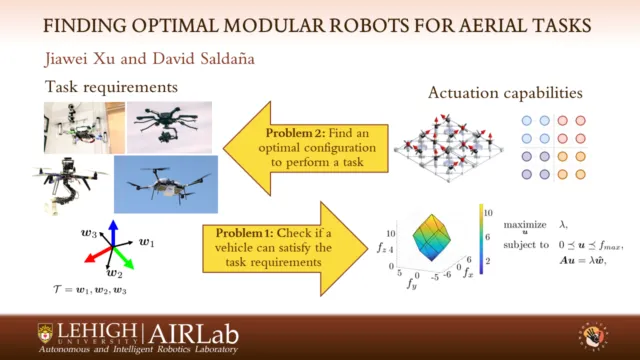 2023Conference paper
Finding Optimal Modular Robots for Aerial Tasks
40th IEEE International Conference on Robotics and Automation
Abstract
Traditional aerial vehicles have limitations in their capabilities due to actuator constraints, such as motor saturation. The hardware components and their arrangement are designed to satisfy specific requirements and are difficult to modify during operation. To address this problem, we introduce a versatile modular multi-rotor vehicle that can change its capabilities by reconfiguration. Our modular robot consists of homogeneous cuboid modules, propelled by quadrotors with tilted rotors. Depending on the number of modules and their configuration, the robot can expand its actuation capabilities. In this paper, we build a mathematical model for the actuation capability of a modular multi-rotor vehicle and develop methods to determine if a vehicle is capable of satisfying a task requirement. Based on this result, we find the optimal configurations for a given task. Our approach is validated in realistic 3D simulations, showing that our modular system can adapt to tasks with varying requirements.
BibTeX
@inproceedings{jiaweixu2023finding, title = {Finding Optimal Modular Robots for Aerial Tasks}, author = {Jiawei Xu and David Saldaña}, url = {https://www.youtube.com/watch?v=JtSZSkYx_Rg, http://swarmslab.com/wp-content/uploads/2023/05/Finding-Optimal-Modular-Robots-for-Aerial-Tasks.pdf}, year = {2023}, date = {2023-05-29}, urldate = {2023-05-29}, booktitle = {40th IEEE International Conference on Robotics and Automation}, organization = {IEEE Robotics and Automation Society}, series = {IEEE International Conference on Robotics and Automation}, abstract = {Traditional aerial vehicles have limitations in their capabilities due to actuator constraints, such as motor saturation. The hardware components and their arrangement are designed to satisfy specific requirements and are difficult to modify during operation. To address this problem, we introduce a versatile modular multi-rotor vehicle that can change its capabilities by reconfiguration. Our modular robot consists of homogeneous cuboid modules, propelled by quadrotors with tilted rotors. Depending on the number of modules and their configuration, the robot can expand its actuation capabilities. In this paper, we build a mathematical model for the actuation capability of a modular multi-rotor vehicle and develop methods to determine if a vehicle is capable of satisfying a task requirement. Based on this result, we find the optimal configurations for a given task. Our approach is validated in realistic 3D simulations, showing that our modular system can adapt to tasks with varying requirements.}, keywords = {aerial robot, computational geometry, modular robots, multi-robot system, optimization}, pubstate = {forthcoming}, tppubtype = {inproceedings} }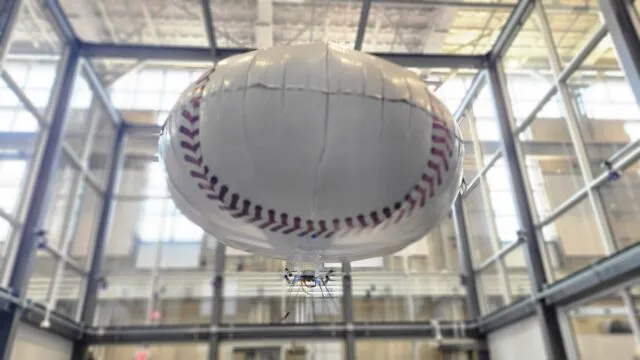 2023Conference paper
SBlimp: Design, Model, and Translational Motion Control for a Swing-Blimp
Jiawei Xu, Diego S. D’Antonio, Dominic J. Ammirato, David Saldaña
2023 IEEE/RSJ International Conference on Intelligent Robots and Systems (IROS 2023)
Abstract
We present an aerial vehicle composed of a custom quadrotor with tilted rotors and a helium balloon, called SBlimp. We propose a novel control strategy that takes advantage of the natural stable attitude of the blimp to control translational motion. Different from cascade controllers in the literature that controls attitude to achieve desired translational motion, our approach directly controls the linear velocity regardless of the heading orientation of the vehicle. As a result, the vehicle swings during the translational motion. We provide a planar analysis of the dynamic model, demonstrating stability for our controller. Our design is evaluated in numerical simulations with different physical factors and validated with experiments using a real-world prototype, showing that the SBlimp is able to achieve stable translation regardless of its orientation.
BibTeX
@inproceedings{xu2023sblimp, title = {SBlimp: Design, Model, and Translational Motion Control for a Swing-Blimp}, author = {Jiawei Xu and Diego S. D’Antonio and Dominic J. Ammirato and David Saldaña}, url = {https://www.researchgate.net/publication/372785641_SBlimp_Design_Model_and_Translational_Motion_Control_for_a_Swing-Blimp}, doi = {10.1109/IROS55552.2023.10341796}, year = {2023}, date = {2023-10-01}, urldate = {2023-10-01}, booktitle = {2023 IEEE/RSJ International Conference on Intelligent Robots and Systems (IROS 2023)}, organization = {IEEE Robotics and Automation Society}, abstract = {We present an aerial vehicle composed of a custom quadrotor with tilted rotors and a helium balloon, called SBlimp. We propose a novel control strategy that takes advantage of the natural stable attitude of the blimp to control translational motion. Different from cascade controllers in the literature that controls attitude to achieve desired translational motion, our approach directly controls the linear velocity regardless of the heading orientation of the vehicle. As a result, the vehicle swings during the translational motion. We provide a planar analysis of the dynamic model, demonstrating stability for our controller. Our design is evaluated in numerical simulations with different physical factors and validated with experiments using a real-world prototype, showing that the SBlimp is able to achieve stable translation regardless of its orientation.}, keywords = {aerial robot, blimp, control}, pubstate = {published}, tppubtype = {inproceedings}, pages = {6977–6982} }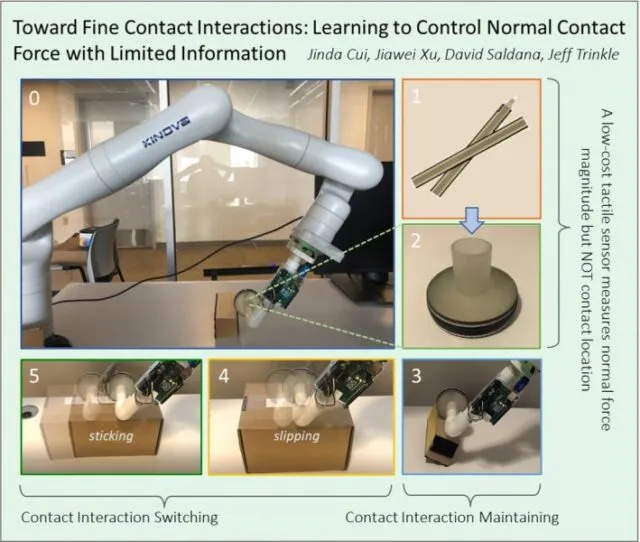 2023Conference paper
Toward Fine Contact Interactions: Learning to Control Normal Contact Force with Limited Information
Jinda Cui, Jiawei Xu, David Saldaña, Jeffrey Trinkle
40th IEEE International Conference on Robotics and Automation
Abstract
Dexterous manipulation of objects through fine control of physical contacts is essential for many important tasks of daily living. A fundamental ability underlying fine contact control is compliant control, i.e., controlling the contact forces while moving. For robots, the most widely explored approaches heavily depend on models of manipulated objects and expensive sensors to gather contact location and force information needed for real-time control. The models are difficult to obtain, and the sensors are costly, hindering personal robots' adoption in our homes and businesses. This study performs model-free reinforcement learning of a normal contact force controller on a robotic manipulation system built with a low-cost, information-poor tactile sensor. Despite the limited sensing capability, our force controller can be combined with a motion controller to enable fine contact interactions during object manipulation. Promising results are demonstrated in non-prehensile, dexterous manipulation experiments.
BibTeX
@inproceedings{jinda2023toward, title = {Toward Fine Contact Interactions: Learning to Control Normal Contact Force with Limited Information}, author = {Jinda Cui and Jiawei Xu and David Saldaña and Jeffrey Trinkle}, year = {2023}, date = {2023-05-29}, urldate = {2023-05-29}, booktitle = {40th IEEE International Conference on Robotics and Automation}, organization = {IEEE Robotics and Automation Society}, abstract = {Dexterous manipulation of objects through fine control of physical contacts is essential for many important tasks of daily living. A fundamental ability underlying fine contact control is compliant control, i.e., controlling the contact forces while moving. For robots, the most widely explored approaches heavily depend on models of manipulated objects and expensive sensors to gather contact location and force information needed for real-time control. The models are difficult to obtain, and the sensors are costly, hindering personal robots' adoption in our homes and businesses. This study performs model-free reinforcement learning of a normal contact force controller on a robotic manipulation system built with a low-cost, information-poor tactile sensor. Despite the limited sensing capability, our force controller can be combined with a motion controller to enable fine contact interactions during object manipulation. Promising results are demonstrated in non-prehensile, dexterous manipulation experiments.}, keywords = {manipulation, robot arm}, pubstate = {forthcoming}, tppubtype = {inproceedings} }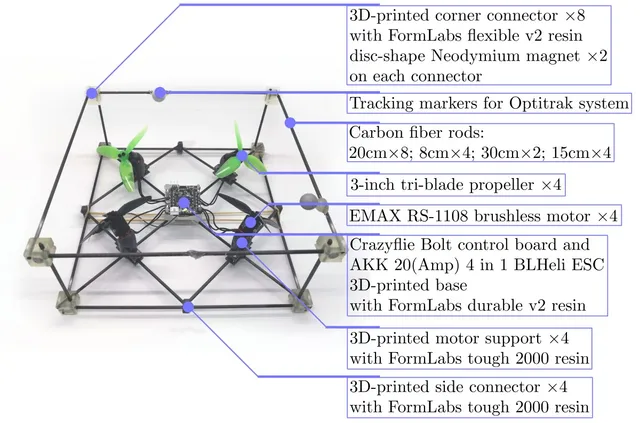 2022Workshop extended abstract
Customizable-ModQuad: a Versatile Hardware-Software Platform to Develop Lightweight and Low-cost Aerial Vehicles
Diego S. D’Antonio, Jiawei Xu, Gustavo A. Cardona, David Saldaña
IROS 2022 Workshop: Miniature Robot Platforms for Full Scale Autonomous Vehicle Research
BibTeX
@misc{2022-customizable-modquad-a-versatile-hardware-software-platform-to-develop-lightweight-and-low-cost-aerial-vehicles, title = {Customizable-ModQuad: a Versatile Hardware-Software Platform to Develop Lightweight and Low-cost Aerial Vehicles}, author = {Diego S. D’Antonio and Jiawei Xu and Gustavo A. Cardona and David Saldaña}, year = {2022}, howpublished = {IROS 2022 Workshop: Miniature Robot Platforms for Full Scale Autonomous Vehicle Research}, url = {https://www.researchgate.net/publication/368390753_Customizable-ModQuad_a_Versatile_Hardware-Software_Platform_to_Develop_Lightweight_and_Low-cost_Aerial_Vehicles} }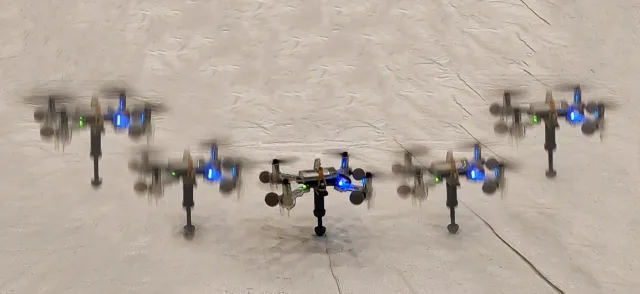 2022Conference paper
PogoDrone: Design, Model, and Control of a Jumping Quadrotor
Brian Zhu, Jiawei Xu, Andrew Charway, David Saldaña
2022 IEEE International Conference on Robotics and Automation
Abstract
We present a design, model, and control for a novel jumping-flying robot that is called PogoDrone. The robot is composed of a quadrotor with a passive mechanism for jumping. The robot can continuously jump in place or fly like a normal quadrotor. Jumping in place allows the robot to quickly move and operate very close to the ground. For instance, in agricultural applications, the jumping mechanism allows the robot to take samples of soil. We propose a hybrid controller that switches from attitude to position control to allow the robot to fall horizontally and recover to the original position. We compare the jumping mode with the hovering mode to analyze the energy consumption. In simulations, we evaluate the effect of different factors on energy consumption. In real experiments, we show that our robot can repeatedly impact the ground, jump, and fly in a physical environment.
BibTeX
@inproceedings{Zhu2022, title = {PogoDrone: Design, Model, and Control of a Jumping Quadrotor}, author = {Brian Zhu and Jiawei Xu and Andrew Charway and David Saldaña}, url = {https://arxiv.org/pdf/2204.00207.pdf}, doi = {https://doi.org/10.48550/arXiv.2204.00207}, year = {2022}, date = {2022-04-01}, urldate = {2022-04-01}, booktitle = {2022 IEEE International Conference on Robotics and Automation}, abstract = {We present a design, model, and control for a novel jumping-flying robot that is called PogoDrone. The robot is composed of a quadrotor with a passive mechanism for jumping. The robot can continuously jump in place or fly like a normal quadrotor. Jumping in place allows the robot to quickly move and operate very close to the ground. For instance, in agricultural applications, the jumping mechanism allows the robot to take samples of soil. We propose a hybrid controller that switches from attitude to position control to allow the robot to fall horizontally and recover to the original position. We compare the jumping mode with the hovering mode to analyze the energy consumption. In simulations, we evaluate the effect of different factors on energy consumption. In real experiments, we show that our robot can repeatedly impact the ground, jump, and fly in a physical environment.}, keywords = {aerial manipulation, aerial robot, quadrotor}, pubstate = {published}, tppubtype = {inproceedings} }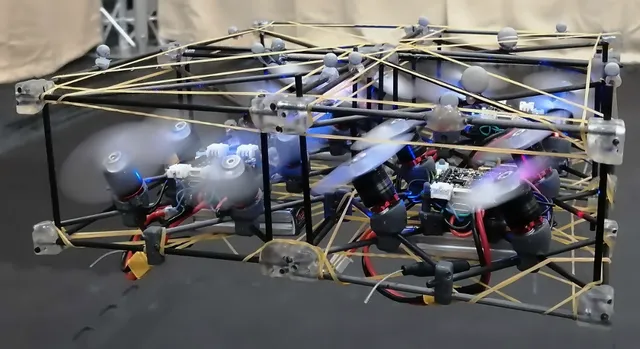 2021Conference paper
H-ModQuad: Modular Multi-Rotors with 4, 5, and 6 Controllable DOF
Jiawei Xu, Diego S. D’Antonio, David Saldaña
2021 IEEE International Conference on Robotics and Automation (ICRA)
Abstract
Traditional aerial vehicles are usually custom-designed for specific tasks. Although they offer an efficient solution, they are not always able to adapt to changes in the task specification, e.g., increasing the payload. This applies to quadrotors, having a maximum payload and only four controllable degrees of freedom, limiting their adaptability to the task’s variations. We propose a versatile modular robotic system that can increase its payload and degrees of freedom by assembling heterogeneous modules; we call it H-ModQuad. It consists of cuboid modules propelled by quadrotors with tilted propellers that can generate forces in different directions. By connecting different types of modules, an H-ModQuad can increase its controllable degrees of freedom from 4 to 5 and 6. We model the general structure and propose three controllers, one for each number of controllable degrees of freedom. We extend the concept of the actuation ellipsoid to find the best reference orientation that can maximize the performance of the structure. Our approach is validated with experiments using actual robots, showing the independence of the translation and orientation of a structure.
BibTeX
@inproceedings{2021-h-modquad-modular-multi-rotors-with-4-5-and-6-controllable-dof,

title = {H-ModQuad: Modular Multi-Rotors with 4, 5, and 6 Controllable DOF},

author = {Jiawei Xu and Diego S. D’Antonio and David Saldaña},

url = {https://youtu.be/olKYuWPWxHo

https://arxiv.org/pdf/2106.04048.pdf},

doi = {10.1109/ICRA48506.2021.9561016},

isbn = {978-1-7281-9077-8},

year  = {2021},

date = {2021-10-18},

urldate = {2021-10-18},

booktitle = {2021 IEEE International Conference on Robotics and Automation (ICRA)},

abstract = {Traditional aerial vehicles are usually custom-designed for specific tasks. Although they offer an efficient solution, they are not always able to adapt to changes in the task specification, e.g., increasing the payload. This applies to quadrotors, having a maximum payload and only four controllable degrees of freedom, limiting their adaptability to the task’s variations. We propose a versatile modular robotic system that can increase its payload and degrees of freedom by assembling heterogeneous modules; we call it H-ModQuad. It consists of cuboid modules propelled by quadrotors with tilted propellers that can generate forces in different directions. By connecting different types of modules, an H-ModQuad can increase its controllable degrees of freedom from 4 to 5 and 6. We model the general structure and propose three controllers, one for each number of controllable degrees of freedom. We extend the concept of the actuation ellipsoid to find the best reference orientation that can maximize the performance of the structure. Our approach is validated with experiments using actual robots, showing the independence of the translation and orientation of a structure.},

keywords = {aerial robot, modquad, modular robots, multi-rotor, quadrotor},

pubstate = {published},

tppubtype = {inproceedings}

}