
Now Assistant Professor at Virginia Commonwealth University
Selected publications
 2022Workshop extended abstract
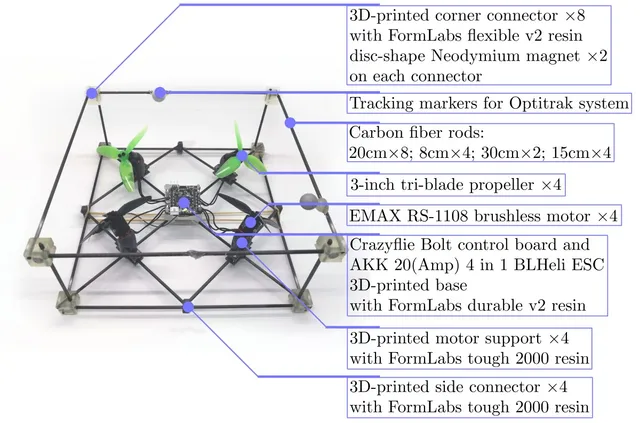
Customizable-ModQuad: a Versatile Hardware-Software Platform to Develop Lightweight and Low-cost Aerial Vehicles
Diego S. D’Antonio, Jiawei Xu, Gustavo A. Cardona, David Saldaña
IROS 2022 Workshop: Miniature Robot Platforms for Full Scale Autonomous Vehicle Research
BibTeX
@misc{2022-customizable-modquad-a-versatile-hardware-software-platform-to-develop-lightweight-and-low-cost-aerial-vehicles, title = {Customizable-ModQuad: a Versatile Hardware-Software Platform to Develop Lightweight and Low-cost Aerial Vehicles}, author = {Diego S. D’Antonio and Jiawei Xu and Gustavo A. Cardona and David Saldaña}, year = {2022}, howpublished = {IROS 2022 Workshop: Miniature Robot Platforms for Full Scale Autonomous Vehicle Research}, url = {https://www.researchgate.net/publication/368390753_Customizable-ModQuad_a_Versatile_Hardware-Software_Platform_to_Develop_Lightweight_and_Low-cost_Aerial_Vehicles} }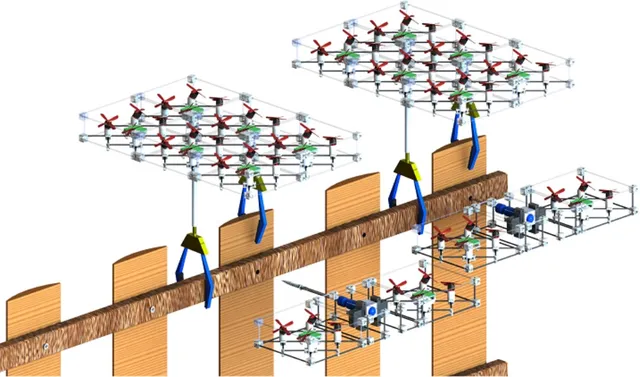 2022Conference paper
Planning for Modular Aerial Robotic Tools with Temporal Logic Constraints
Gustavo A. Cardona, David Saldaña, Cristian-Ioan Vasile
2022 IEEE 61st Conference on Decision and Control (CDC)
BibTeX
@inproceedings{2022-planning-for-modular-aerial-robotic-tools-with-temporal-logic-constraints, title = {Planning for Modular Aerial Robotic Tools with Temporal Logic Constraints}, author = {Gustavo A. Cardona and David Saldaña and Cristian-Ioan Vasile}, year = {2022}, booktitle = {2022 IEEE 61st Conference on Decision and Control (CDC)}, pages = {2878-2883}, doi = {10.1109/cdc51059.2022.9993288}, url = {https://doi.org/10.1109/cdc51059.2022.9993288} }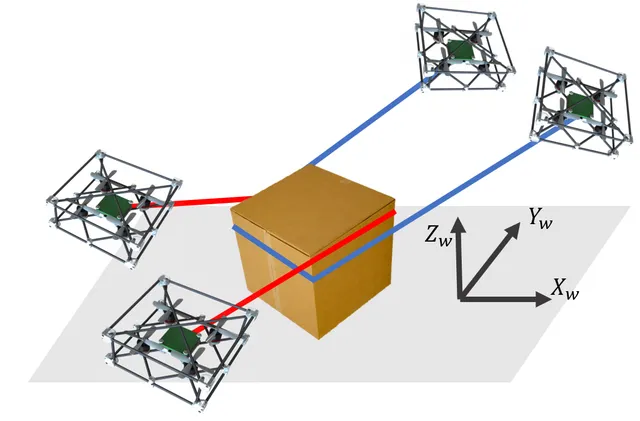 2021Conference paper
Adaptive Control for Cooperative Aerial Transportation Using Catenary Robots
Gustavo A. Cardona, Diego S. D’Antonio, Rafael Fierro, David Saldaña
2021 Aerial Robotic Systems Physically Interacting with the Environment (AIRPHARO)
BibTeX
@inproceedings{9571068, title = {Adaptive Control for Cooperative Aerial Transportation Using Catenary Robots}, author = {Gustavo A. Cardona and Diego S. D’Antonio and Rafael Fierro and David Saldaña}, url = {https://youtu.be/MeEGL_PUBx4}, doi = {10.1109/AIRPHARO52252.2021.9571068}, year = {2021}, date = {2021-01-01}, urldate = {2021-01-01}, booktitle = {2021 Aerial Robotic Systems Physically Interacting with the Environment (AIRPHARO)}, pages = {1-8}, keywords = {aerial manipulation, aerial robot, cable, catenary robot, quadrotor}, pubstate = {published}, tppubtype = {inproceedings} }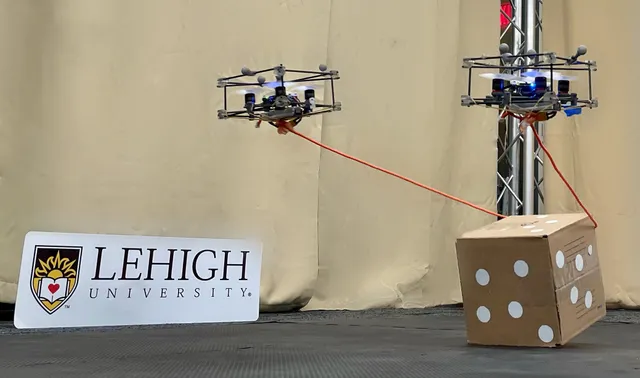 2021Conference paper
Non-Prehensile Manipulation of Cuboid Objects Using a Catenary Robot
Gustavo A. Cardona, Diego S. D’Antonio, Cristian-Ioan Vasile, David Saldaña
Abstract
Transporting objects using quadrotors with cables has been widely studied in the literature. However, most of those approaches assume that the cables are previously attached to the load by human intervention. In tasks where multiple objects need to be moved, the efficiency of the robotic system is constrained by the requirement of manual labor. Our approach uses a non-stretchable cable connected to two quadrotors, which we call the catenary robot, that fully automates the transportation task. Using the cable, we can roll and drag the cuboid object (box) on planar surfaces. Depending on the surface type, we choose the proper action, dragging for low friction, and rolling for high friction. Therefore, the transportation process does not require any human intervention as we use the cable to interact with the box without requiring fastening. We validate our control design in simulation and with actual robots, where we show them rolling and dragging boxes to track desired trajectories.
BibTeX
@inproceedings{2021-non-prehensile-manipulation-of-cuboid-objects-using-a-catenary-robot, title = {Non-Prehensile Manipulation of Cuboid Objects Using a Catenary Robot}, author = {Gustavo A. Cardona and Diego S. D’Antonio and Cristian-Ioan Vasile and David Saldaña}, url = {https://youtu.be/Ou6DPlXPE7A}, year = {2021}, date = {2021-08-13}, urldate = {2021-08-13}, abstract = {Transporting objects using quadrotors with cables has been widely studied in the literature. However, most of those approaches assume that the cables are previously attached to the load by human intervention. In tasks where multiple objects need to be moved, the efficiency of the robotic system is constrained by the requirement of manual labor. Our approach uses a non-stretchable cable connected to two quadrotors, which we call the catenary robot, that fully automates the transportation task. Using the cable, we can roll and drag the cuboid object (box) on planar surfaces. Depending on the surface type, we choose the proper action, dragging for low friction, and rolling for high friction. Therefore, the transportation process does not require any human intervention as we use the cable to interact with the box without requiring fastening. We validate our control design in simulation and with actual robots, where we show them rolling and dragging boxes to track desired trajectories.}, keywords = {aerial manipulation, aerial robot, cable, catenary robot, quadrotor}, pubstate = {published}, tppubtype = {inproceedings} }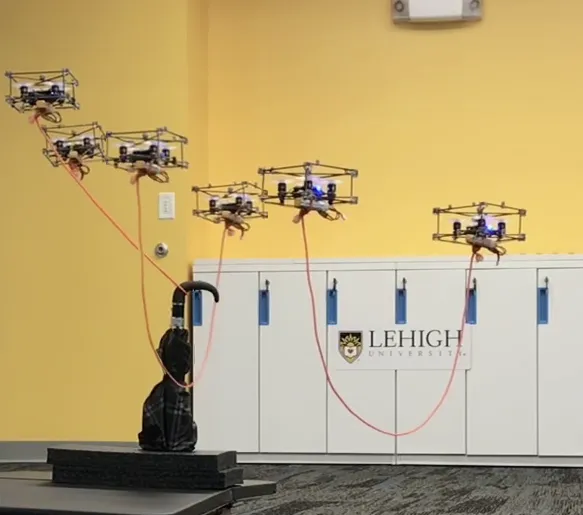 2021Journal article
The Catenary Robot: Design and Control of a Cable Propelled by Two Quadrotors
Diego S. D’Antonio, Gustavo A. Cardona, David Saldaña
IEEE Robotics and Automation Letters
Abstract
Transporting objects using aerial robots has been widely studied in the literature. Still, those approaches always assume that the connection between the quadrotor and the load is made in a previous stage. However, that previous stage usually requires human intervention, and autonomous procedures to locate and attach the object are not considered. Additionally, most of the approaches assume cables as rigid links, but manipulating cables requires considering the state when the cables are hanging. In this work, we design and control a catenary robot. Our robot is able to transport hook-shaped objects in the environment. The robotic system is composed of two quadrotors attached to the two ends of a cable. By defining the catenary curve with five degrees of freedom, position in 3-D, orientation in z-axis, and span, we can drive the two quadrotors to track a given trajectory. We validate our approach with simulations and real robots. We present four different scenarios of experiments. Our numerical solution is computationally fast and can be executed in real-time.
BibTeX
@article{2021-the-catenary-robot-design-and-control-of-a-cable-propelled-by-two-quadrotors,

title = {The Catenary Robot: Design and Control of a Cable Propelled by Two Quadrotors},

author = {Diego S. D’Antonio and Gustavo A. Cardona and David Saldaña },

url = {https://youtu.be/3SaKKjl6os0},

doi = {10.1109/LRA.2021.3062603},

issn = {2377-3766},

year  = {2021},

date = {2021-02-26},

urldate = {2021-02-26},

journal = {IEEE Robotics and Automation Letters},

volume = {6},

number = {2},

pages = {3857-3863},

abstract = {Transporting objects using aerial robots has been widely studied in the literature. Still, those approaches always assume that the connection between the quadrotor and the load is made in a previous stage. However, that previous stage usually requires human intervention, and autonomous procedures to locate and attach the object are not considered. Additionally, most of the approaches assume cables as rigid links, but manipulating cables requires considering the state when the cables are hanging. In this work, we design and control a catenary robot. Our robot is able to transport hook-shaped objects in the environment. The robotic system is composed of two quadrotors attached to the two ends of a cable. By defining the catenary curve with five degrees of freedom, position in 3-D, orientation in z-axis, and span, we can drive the two quadrotors to track a given trajectory. We validate our approach with simulations and real robots. We present four different scenarios of experiments. Our numerical solution is computationally fast and can be executed in real-time.},

keywords = {aerial manipulation, aerial robot, cable, catenary robot, quadrotor},

pubstate = {published},

tppubtype = {article}

}