What we do
Research
We work with cooperative multi-robot systems that can scale to robot swarms. Our projects cover aerial robots that cooperate through physical interaction and resilient multi-robot networks.
01 / The Catenary Robot
Collaborative manipulation
From ancient times, humans have been using cables and ropes to carry, tie, and manipulate physical objects. Transporting objects using aerial robots has been widely studied in the literature. Still, those approaches always assume that the connection between the quadrotor and the load is made in a previous stage. We propose a versatile robot called “Catenary Robot.” Our robot is able to navigate in the environment to get attached to objects with a hook-like shape or Drag/Rotate objects. Further, this new platform allows aerial robots to perform non-apprehensive object manipulation and perform actions such as push, drag, and roll.
Explore related publications →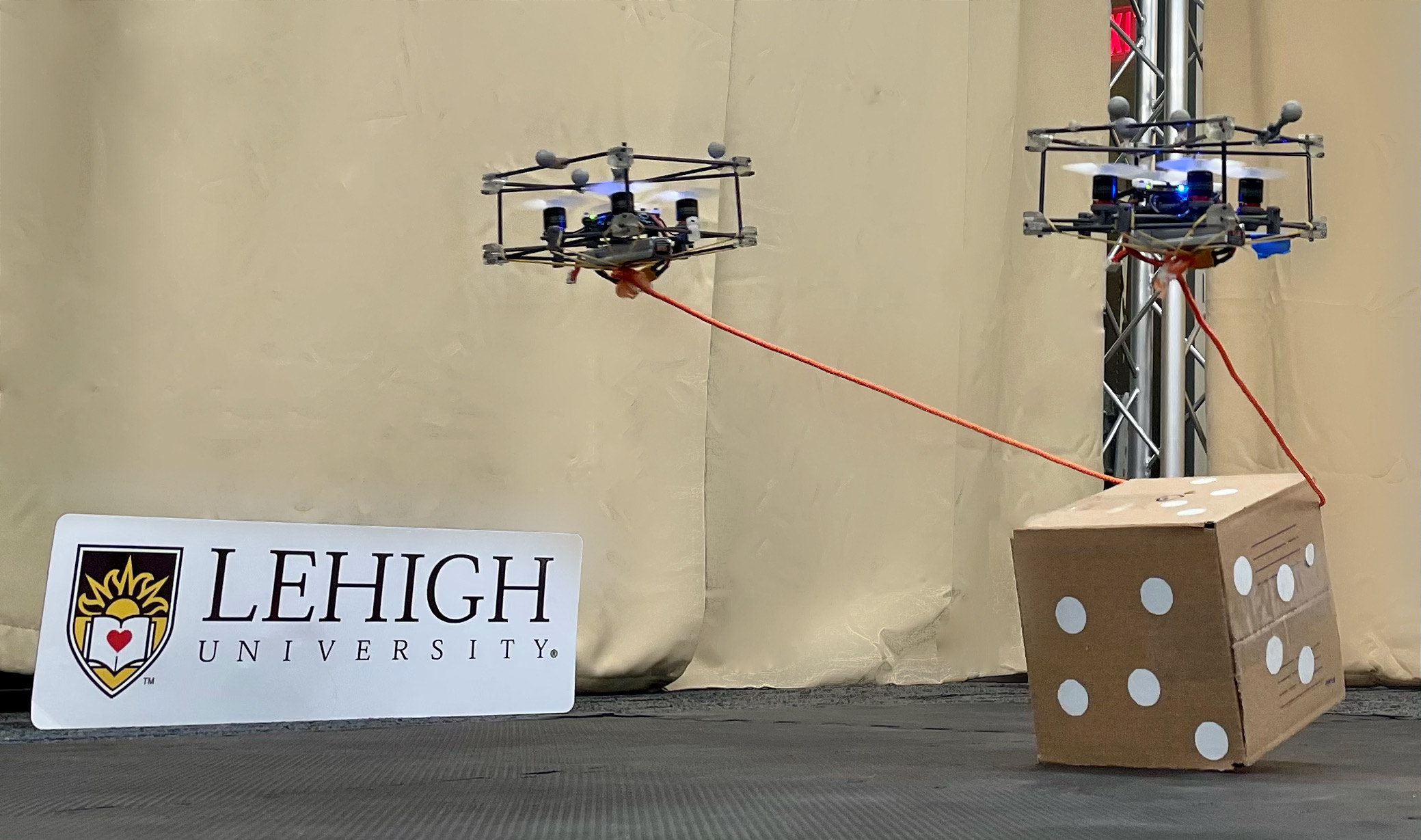
 2026Conference paper
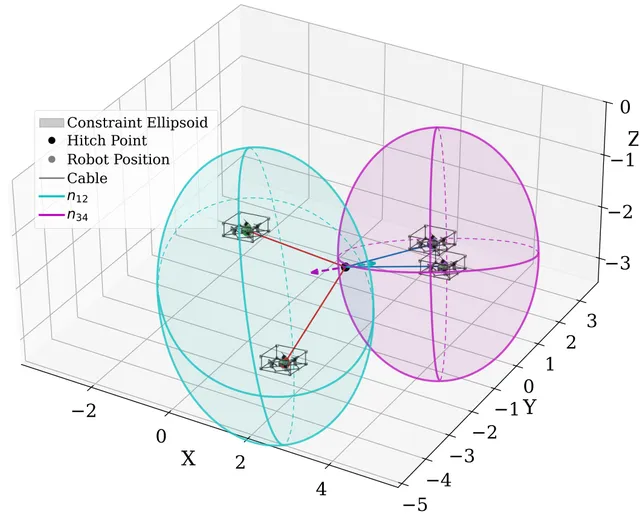
From Ellipsoids to Midair Control of Dynamic Hitches
Jiawei Xu, Subhrajit Bhattacharya, David Saldaña
2026 American Control Conference (ACC)
BibTeX
@inproceedings{xu2026ellipsoids, title={From Ellipsoids to Midair Control of Dynamic Hitches}, author={Xu, Jiawei and Bhattacharya, Subhrajit and Saldaña, David}, booktitle={2026 American Control Conference (ACC)}, year={2026}, url={https://arxiv.org/abs/2602.08116} }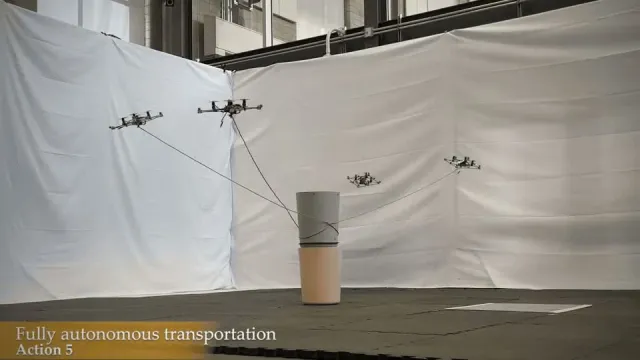 2026Journal article
From Hitch to Lift: Autonomous Cable Interlacing by Multi-UAV Teams for Aerial Grasping and Transportation
Diego S. D'Antonio, Tongshu Wu, Subhrajit Bhattacharya, David Saldaña
IEEE Transactions on Robotics
BibTeX
@article{2026-from-hitch-to-lift-autonomous-cable-interlacing-by-multi-uav-teams-for-aerial-grasping-and-transportation,
  title = {From Hitch to Lift: Autonomous Cable Interlacing by Multi-UAV Teams for Aerial Grasping and Transportation},
  author = {Diego S. D'Antonio and Tongshu Wu and Subhrajit Bhattacharya and David Saldaña},
  year = {2026},
  journal = {IEEE Transactions on Robotics},
  doi = {10.1109/tro.2026.3677011}
}
02 / ModQuad & H-ModQuad
Modular aerial robots
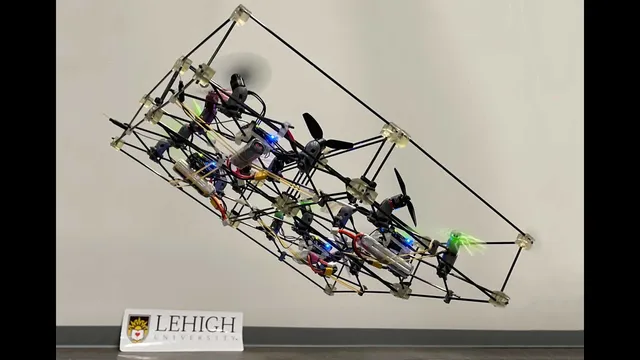
The principle behind our modular aerial robots is having minimalistic modules that can fly and self-assemble to form a more capable vehicle that can adapt to different task requirements. Currently, our modular aerial vehicles, H-ModQuad, include two types and four versions. Our work is focused on tasks such as on-flight reconfiguration, increasing controllable DoF, and forming collaborative manipulations. We are also working on integrating tools and different manipulators as part of the modular system.
Explore related publications →
 2025Journal article
Modular Multirotors: From Quadrotors to Fully-Actuated Aerial Vehicles
Jiawei Xu, Diego S. D'Antonio, David Saldaña
IEEE Transactions on Automation Science and Engineering
BibTeX
@article{2025-modular-multirotors-from-quadrotors-to-fully-actuated-aerial-vehicles, title = {Modular Multirotors: From Quadrotors to Fully-Actuated Aerial Vehicles}, author = {Jiawei Xu and Diego S. D'Antonio and David Saldaña}, year = {2025}, journal = {IEEE Transactions on Automation Science and Engineering}, pages = {19328-19339}, volume = {22}, doi = {10.1109/tase.2025.3594579}, url = {https://doi.org/10.1109/tase.2025.3594579} } 2025Book chapter
Reconfigurable Systems
David Saldaña, Gedaliah Knizhnik, Bruno Gabrich, Mark Yim
Encyclopedia of Robotics
BibTeX
@incollection{2025-reconfigurable-systems, title = {Reconfigurable Systems}, author = {David Saldaña and Gedaliah Knizhnik and Bruno Gabrich and Mark Yim}, year = {2025}, booktitle = {Encyclopedia of Robotics}, url = {https://scholar.google.com/citations?view_op=view_citation&hl=en&user=VU1s_Z8AAAAJ&citation_for_view=VU1s_Z8AAAAJ:sNmaIFBj_lkC} }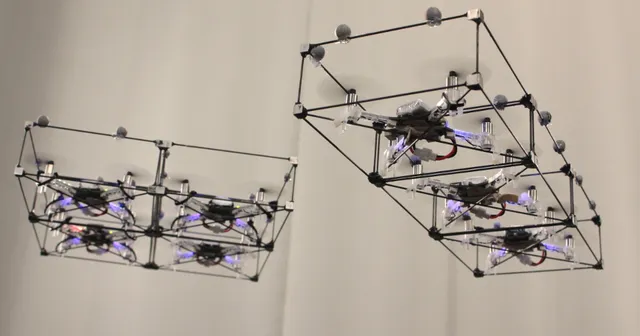 2018Conference paper
ModQuad: The Flying Modular Structure that Self-Assembles in Midair
David Saldaña, Bruno Gabrich, Guanrui Li, Mark Yim, Vijay Kumar
2018 IEEE International Conference on Robotics and Automation (ICRA)
BibTeX
@inproceedings{icra18modquad,

title = {ModQuad: The Flying Modular Structure that Self-Assembles in Midair},

author = {David Saldaña and Bruno Gabrich and Guanrui Li and Mark Yim and Vijay Kumar},

url = {https://youtu.be/t9kXrhDwXf0},

doi = {10.1109/ICRA.2018.8461014},

issn = {2577-087X},

year  = {2018},

date = {2018-05-01},

urldate = {2018-05-01},

booktitle = {2018 IEEE International Conference on Robotics and Automation (ICRA)},

pages = {691-698},

keywords = {aerial robot, modquad, modular robots, multi-rotor, quadrotor, self-reconfiguration algorithms},

pubstate = {published},

tppubtype = {inproceedings}

}
03
Lighter Than Air (LTA) Swarms
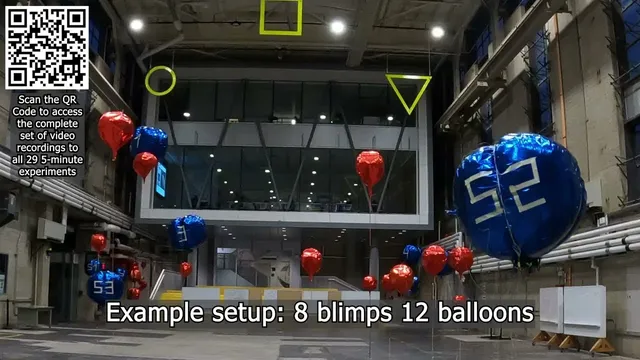
Lightweight, energy-efficient aerial vehicles and platforms for multi-robot autonomy.
 2025Conference paper
MochiSwarm: A testbed for robotic blimps in realistic environments
Jiawei Xu, Thong Vu, Diego S. D’Antonio, David Saldaña
IEEE International Conference on Robotics and Automation (ICRA)
BibTeX
@inproceedings{2025-mochiswarm, title = {MochiSwarm: A testbed for robotic blimps in realistic environments}, author = {Jiawei Xu and Thong Vu and Diego S. D’Antonio and David Saldaña}, year = {2025}, booktitle = {IEEE International Conference on Robotics and Automation (ICRA)}, url = {https://arxiv.org/abs/2503.03077} }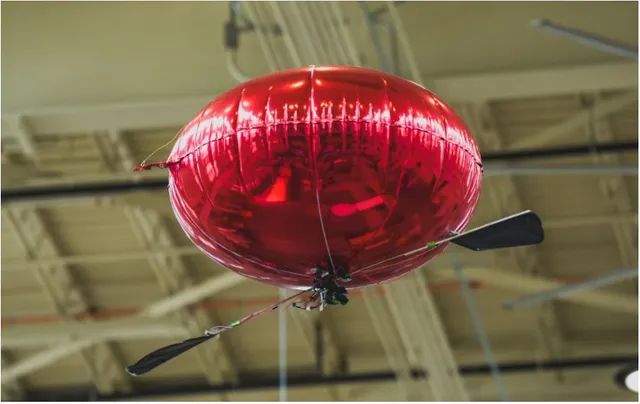 2025Conference paper
The Spinning Blimp: Design and Control of a Novel Minimalist Aerial Vehicle Leveraging Rotational Dynamics and Locomotion
Leonardo Santens, Diego S. D’Antonio, Shuhang Hou, David Saldaña
IEEE International Conference on Robotics and Automation (ICRA)
BibTeX
@inproceedings{2025-spinning-blimp, title = {The Spinning Blimp: Design and Control of a Novel Minimalist Aerial Vehicle Leveraging Rotational Dynamics and Locomotion}, author = {Leonardo Santens and Diego S. D’Antonio and Shuhang Hou and David Saldaña}, year = {2025}, booktitle = {IEEE International Conference on Robotics and Automation (ICRA)}, url = {https://arxiv.org/abs/2503.04112} } 2024Conference paper
KT-Imitation: Efficient Visual Imitation for Autonomous Navigation Based on Keypoint Timeline
Karen Li, Hanqing Qi, Jiawei Xu, Edward Jeffs, David Saldaña
2024 Latin American Robotics Symposium (LARS)
BibTeX
@inproceedings{2024-kt-imitation-efficient-visual-imitation-for-autonomous-navigation-based-on-keypoint-timeline,
  title = {KT-Imitation: Efficient Visual Imitation for Autonomous Navigation Based on Keypoint Timeline},
  author = {Karen Li and Hanqing Qi and Jiawei Xu and Edward Jeffs and David Saldaña},
  year = {2024},
  booktitle = {2024 Latin American Robotics Symposium (LARS)},
  doi = {10.1109/lars64411.2024.10786409}
}
04 / Coordination at scale
Resilient robot swarms
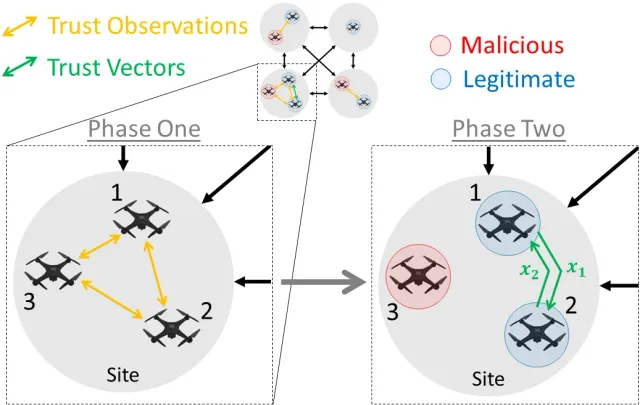
The communication network of a distributed system is an essential part of coordination. Robots can achieve agreements by only using nearest neighbor communication, but such systems rely on the fact that all robots in the network are cooperative. As a consequence, large networks, composed of thousands of robots, are susceptible to failure when one or a small number of robots share wrong information. These non-cooperative robots can be defective (e.g., a robot with a malfunctioning location sensor) or attackers (e.g., a malicious outsider controlling a few robots and trying to manipulate the whole network). In both cases, the divergent wrong information in the distributed system directly impacts the possibility to complete the task.
Explore related publications →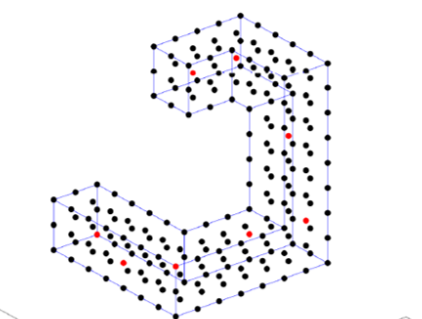
 2025Journal article
quasi-Dynamic Crowd Vetting: Collaborative Detection of Malicious Robots in Dynamic Communication Networks
Matthew Cavorsi, Frederik Mallmann-Trenn, David Saldaña, Stephanie Gil
IEEE Transactions on Robotics
BibTeX
@article{2025-quasi-dynamic-crowd-vetting-collaborative-detection-of-malicious-robots-in-dynamic-communication-networks, title = {quasi-Dynamic Crowd Vetting: Collaborative Detection of Malicious Robots in Dynamic Communication Networks}, author = {Matthew Cavorsi and Frederik Mallmann-Trenn and David Saldaña and Stephanie Gil}, year = {2025}, journal = {IEEE Transactions on Robotics}, pages = {5533-5549}, volume = {41}, doi = {10.1109/tro.2025.3608702}, url = {https://doi.org/10.1109/tro.2025.3608702} }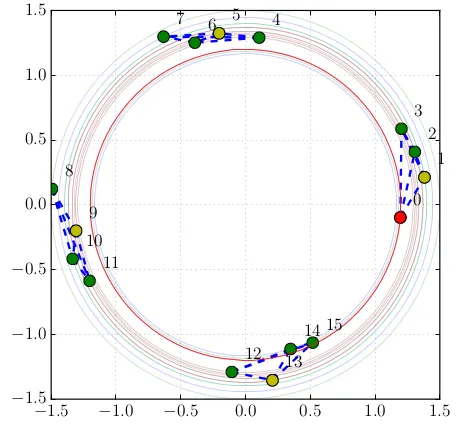 2017Conference paper
Resilient consensus for time-varying networks of dynamic agents
David Saldaña, Amanda Prorok, Shreyas Sundaram, Mario F. M. Campos, Vijay Kumar
2017 American Control Conference (ACC)
BibTeX
@inproceedings{7962962, title = {Resilient consensus for time-varying networks of dynamic agents}, author = {David Saldaña and Amanda Prorok and Shreyas Sundaram and Mario F. M. Campos and Vijay Kumar}, doi = {10.23919/ACC.2017.7962962}, year = {2017}, date = {2017-01-01}, urldate = {2017-01-01}, booktitle = {2017 American Control Conference (ACC)}, pages = {252-258}, keywords = {resilient consensus, robot networks, robot swarms}, pubstate = {published}, tppubtype = {inproceedings} }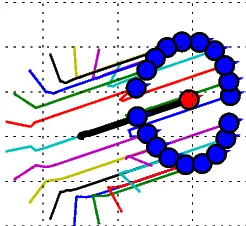 2017Journal article
Resilient Flocking for Mobile Robot Teams
Kelsey Saulnier, David Saldaña, Amanda Prorok, George J. Pappas, Vijay Kumar
IEEE Robotics and Automation Letters
BibTeX
@article{7822915,

title = {Resilient Flocking for Mobile Robot Teams},

author = {Kelsey Saulnier and David Saldaña and Amanda Prorok and George J. Pappas and Vijay Kumar},

doi = {10.1109/LRA.2017.2655142},

year  = {2017},

date = {2017-01-01},

urldate = {2017-01-01},

journal = {IEEE Robotics and Automation Letters},

volume = {2},

number = {2},

pages = {1039-1046},

keywords = {resilient consensus, robot networks, robot swarms},

pubstate = {published},

tppubtype = {article}

}
05
Environmental monitoring
Robotic sensor networks that estimate and track evolving environmental boundaries.
 2021Journal article
Estimating boundary dynamics using robotic sensor networks with pointwise measurements
David Saldana, Renato Assunçao, M. Ani Hsieh, Mario F.M. Campos, Vijay Kumar
Autonomous Robots
BibTeX
@article{auros18, title = {Estimating boundary dynamics using robotic sensor networks with pointwise measurements}, author = {David Saldana and Renato Assunçao and M. Ani Hsieh and Mario F.M. Campos and Vijay Kumar}, year = {2021}, date = {2021-01-01}, urldate = {2021-01-01}, journal = {Autonomous Robots}, volume = {45}, number = {2}, pages = {193--208}, publisher = {Springer}, keywords = {boundary estimation, environmental monitoring, multi-robot system, robot boat, robot sensor network}, pubstate = {published}, tppubtype = {article} } 2017Conference paper
Cooperative prediction of time-varying boundaries with a team of robots
David Saldaña, Renato Assunção, M. Ani Hsieh, Mario F. M. Campos, Vijay Kumar
2017 International Symposium on Multi-Robot and Multi-Agent Systems (MRS)
BibTeX
@inproceedings{8250925, title = {Cooperative prediction of time-varying boundaries with a team of robots}, author = {David Saldaña and Renato Assunção and M. Ani Hsieh and Mario F. M. Campos and Vijay Kumar}, doi = {10.1109/MRS.2017.8250925}, year = {2017}, date = {2017-01-01}, urldate = {2017-01-01}, booktitle = {2017 International Symposium on Multi-Robot and Multi-Agent Systems (MRS)}, pages = {9-16}, keywords = {resilient consensus, robot networks, robot swarms}, pubstate = {published}, tppubtype = {inproceedings} } 2016Journal article
Predicting Environmental Boundary Behaviors With a Mobile Robot
David Saldaña, Renato Assunção, Mario F. M. Campos
IEEE Robotics and Automation Letters
BibTeX
@article{ral16,

title = {Predicting Environmental Boundary Behaviors With a Mobile Robot},

author = {David Saldaña and Renato Assunção and Mario F. M. Campos},

doi = {10.1109/LRA.2016.2522500},

issn = {2377-3766},

year  = {2016},

date = {2016-07-01},

urldate = {2016-07-01},

journal = {IEEE Robotics and Automation Letters},

volume = {1},

number = {2},

pages = {1133-1139},

keywords = {boundary estimation, environmental monitoring, multi-robot system, robot sensor network},

pubstate = {published},

tppubtype = {article}

}